


What the digital business model taught me?
- hx2370

- Apr 3, 2020
- 3 min read
After getting up, Jack was well-dressed and ready to go to work. He wanted to have a cup of coffee but the meeting at 9 o'clock in the morning was about to be late. At this time, his cell phone informed him that the meeting was postponed in time, and he could just enjoy a cup of coffee. After drinking coffee, Jack went out to work. He drove to the train station and navigated to help him choose the best parking space based on his current location. After Jack confirms, the car automatically stops at the selected parking space. On the train, the ticket checking equipment automatically detected the monthly ticket carried by Jack, and at the same time transmitted his information to the train's food service system, automatically reminding the waiter to accurately deliver Jack's favourite food and drinks to the seat. No order or interruption is required, the system automatically deducts the corresponding charges from Jack's credit card. In just one morning, Jack has enjoyed the benefits of being in the digital world many times.

1. My experience in the course
By studying the BEMM129 course, we can easily discover that the Jack experience described in this article can now be truly realized in real life. These changes are the epitome of the digital world and my outlook for the future of digital life. By 2020, more than seven billion people and businesses, and at least 30 billion devices, will be connected to the Internet. With people, businesses and things communicating, transacting, and even negotiating with each other, a new world comes into being - the world of digital business(Lopez, 2014). The memory capacity and processing power of machines are greatly increased, which expand the volumes and granularity of data (Deloitte, 2019). Moreover, Blockchain, with its traceability and transparency, changes the way every transaction is recorded and therefore real-time reporting become possible (EY, 2020).

2. My classmates gave me their opinions
In the study, I learned more about the development of the digital business world by browsing other students ’blogs. For example, recent Uber can see Uber's operation and growth model from Miao's blog. We can see that Uber has achieved good results, but how to solve the problems of passengers ’personal safety and information security is still plaguing them. In terms of digital music, QQ Music beat other competitors by seizing the digital opportunity Giants in the industry. But copyright security issues are also a headache for them. Through Amelia's blog post, I also learned about the benefits of digitalization for commercial banks. But how to ensure the security of customer account information, various commercial banks are still trying to find a way out. Today, each company has achieved digitization to a certain extent. According to Gartner, only companies that can creatively merge the physical and digital worlds to achieve business goals can truly be called digital companies.

By studying the BEMM129 course, we can find that although new technologies may bring potential risks such as widening gaps, the future of digitalization is irreversible. To succeed in the future, as PwC suggests: “It is the mindset – the willingness to work with new, innovative technology solutions – that must first change” (PwC, 2017). I am looking forward to the future development of the digital world. I will focus on how to solve security problems. I believe that in the process of combining future strategies and technologies, we will slowly find an exit that breaks through the shadow of security. At the same time, I also In my paper, I will apply research on digitalization and tax compliance issues.In the future, the work of manual tax collection by tax collectors may be gradually weakened or eliminated, and various electronic declaration methods such as online declaration, telephone declaration and bank declaration will replace it. (Gulyás and Hammer, n.d.)
Reference
Digital Business in Everyone’s Business. Jorge Lopez, Forbes. Retrieved from https://www.forbes.com/sites/gartnergroup/2014/05/07/digital-business-is-everyones-business/#64dfef037f82
Gerald C. KanePalmer, Anh Nguyen PhillipsDoug. (2015).
MIT Sloan Management Review: http://sloanreview.mit.edu/topic/digital
Gulyás, A. and Hammer, F. (n.d.). Public service media in the digital age.
Our Digital Future: A Perspective for tax professionals. (2019). Retrieved from Deloitte: https://www2.deloitte.com/content/dam/Deloitte/global/Documents/Tax/dttl-tax-deloitte-our-digital-future.pdf
The Tax Professional of the Future. (2017). Retrieved from PwC:
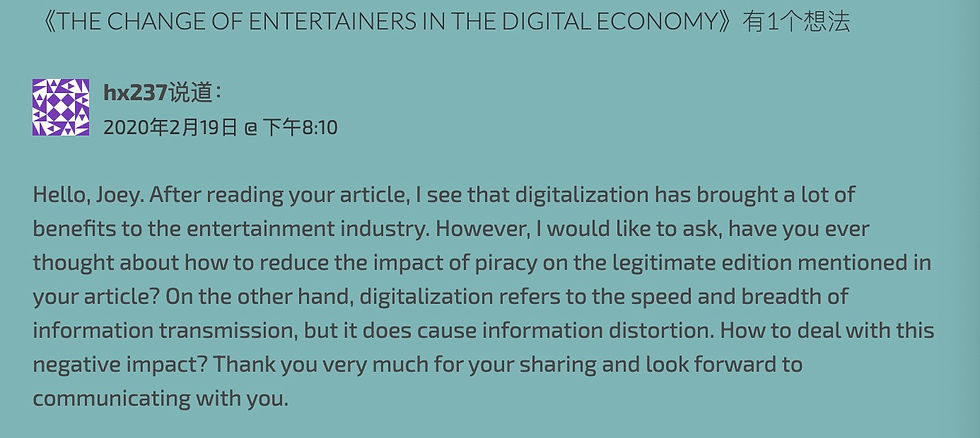
Link to the comment:
Qingqing Miao' blog link: https://qingqingmiao.tech.blog/2020/03/06/post-3-uberdisruptive-innovation/
Jiang Zhou' blog link: https://joeyzhou.design.blog/2020/03/06/the-digital-business-for-qq-music/
Shuang Liu' blog link: https://sl7828.wixsite.com/mysite/post/achievements-of-digital-transformation-of-commercial-banks-a-case-study-of-china-citic-bank




Comments